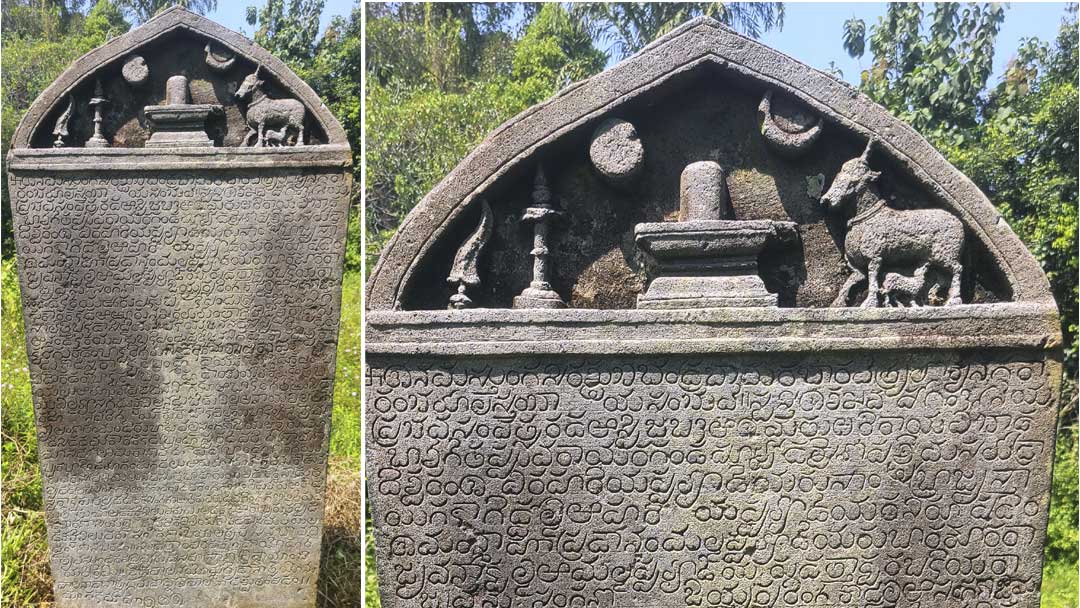

Udupi : A historical Vijayanagara-era inscription has been discovered at Dasanda Bakimar, near the Jumadi temple in Kedinje village of Belman, Karkala taluk, Udupi district. According to a press release by Prof. Murugeshi T., founder trustee of Adimakala Trust (R.), Udupi, the inscription is carved on a green schist (soapstone) slab measuring 46.5 cm in height and 23 cm in width. Written in the Kannada language and script, the text also incorporates several Tulu words. The stone slab features a rectangular lower panel containing 34 lines of inscription, while the upper panel displays bas-relief sculptures depicting a central Shiva Lingam, a cow feeding its calf on the left, and a lamp post alongside a ‘Kadsale’ (a ceremonial sword used in Bhuta worship) on the right.
The inscription opens with an engraved auspicious Swastika symbol, followed by an invocation to Lord Shiva. Although the recorded date reads Saka year 1039, Prabhava Samvatsara, Bahula 3—which does not align with the Vijayanagara period—historical analysis indicates the intended date is Saka 1309, corresponding to 1387 A.D., where the Prabhava year matches perfectly. The text praises the Vijayanagara ruler Harihara II, referring to him as the lord of the three oceans (Purva Dakshina Paschima Samudradhisvaram). It records that under the royal decree of King Harihara II (Hariyappa Vodeya), Prime Minister (Maha Pradhana) Mallappa Vodeya was governing the Barakuru region.
As per the inscription, Mallappa Vodeya assigned the governance of Dattaluva kingdom to Sanganna Jaya Arasa. Subsequently, Sanganna Jaya Arasa granted two tax-free ‘balikes’ (land grants) at Nandalike as ‘Brahmadaya’ to Kotishvaralva and Kadambalva. Out of these two land grants, six ‘mude’ of paddy was specified to be paid annually to a Brahmin who taught the Puranas. The record explicitly directs the two brothers to hand over this annual grant without fail according to the deed of Dharma established by Jaya Arasa. It further stipulates a penalty of 250 gadyanas to the king and 150 gadyanas to the deity in case anyone or the state attempts to evade or violate this charitable deed. The document was authored by Senabova Vittanna under the patronage of Jaya Arasa and concludes with traditional imprecatory verses.
The existence and precise location of this inscription were brought to light by Sinchith M. and Shodan B., first-year B.A. Archaeology students from MSRS College, Shirva. Expressing his gratitude to the students, Prof. Murugeshi T. also extended his sincere thanks to Suhas Hegde of the Nandalike Palace, his mother Sarala S. Hegde, Dr. Suresh Chitrapu (President of Gajani Foundation, Mulki), and Dr. Raghuram Shetty of the Rani Chikkayi Tayi Charitable Trust (R.), Gulladi for their support in the discovery and documentation process.



Leave a Reply
Leave a Reply
Posted in: Regional News, Latest News, News, top-featured