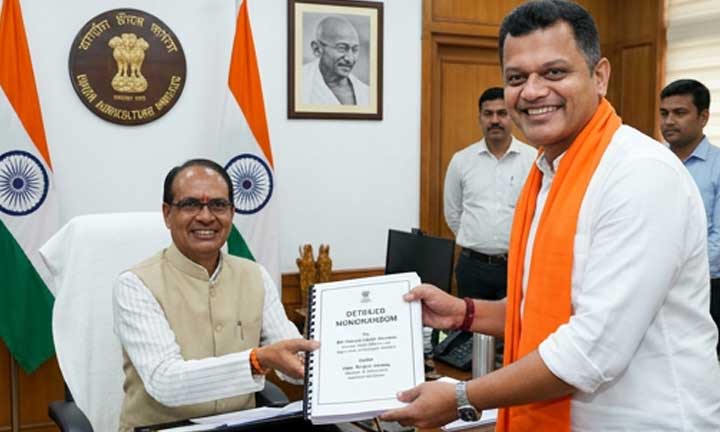

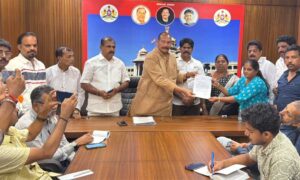
New Delhi : Dakshina Kannada Member of Parliament Capt. Brijesh Chowta has submitted a detailed memorandum to Union Agriculture Minister Shivraj Singh Chouhan in New Delhi, urging immediate central intervention to tackle the severe outbreak of ‘Yellow Leaf Disease’ and ‘Leaf Spot Disease’ affecting arecanut plantations. He highlighted that the rapid spread of these diseases across the coastal and Malnad regions of Karnataka, including Dakshina Kannada, Chikkamagaluru, and Kodagu, has severely crippled the financial stability of lakhs of farmers. Yellow Leaf Disease alone has devastated nearly 16,000 hectares of plantations, leaving farmers in deep distress due to the lack of an outright cure for the underlying ‘Phytoplasma’ infection. Currently, the management strategies devised by the ICAR-Central Plantation Crops Research Institute (CPCRI) serve as the sole ray of hope. Capt. Chowta lauded CPCRI’s breakthrough in creating a high-tech diagnostic laboratory at Vittal and successfully producing disease-resistant tissue-cultured plantlets. However, he emphasized that large-scale adoption of these advanced technologies, alongside high-tech irrigation and balanced nutrient management systems, urgently requires substantial institutional and financial backing through a comprehensive central assistance package.
The Member of Parliament also raised grave concerns regarding the widespread escalation of Leaf Spot Disease across the region. He recalled that in 2023, based on a scientific report by an ICAR-CPCRI expert panel, the central government under the guidance of then Union Minister of State for Agriculture Shobha Karandlaje had sanctioned ₹225 crore with a 60:40 funding ratio between the Centre and State. However, a major technical hurdle arose as this fund was linked to the strict guidelines of the Mission for Integrated Development of Horticulture (MIDH). Under standard MIDH rules, plant protection expenditure is strictly capped at a maximum of ₹1,500 per hectare. According to CPCRI assessments, the actual cost of implementing an integrated control regime—which involves highly specialized fungicides and intensive nutrient management—far exceeds this threshold. Consequently, due to this limiting technicality, the massive grant could not be utilized for its intended purpose and lapsed back to the government treasury, intensifying the vulnerability of the farming community.
To rectify this administrative bottleneck, Capt. Chowta urged the Union Agriculture Minister to urgently intervene and grant a special waiver from standard MIDH cost ceilings specifically for combating Leaf Spot Disease. He requested the re-release of the previously sanctioned funds to match the realistic, scientific cost structures recommended by the CPCRI, noting that accurate financial support is crucial for the survival of the country’s arecanut sector. Recognizing the vital role of arecanut cultivation in the socio-economic framework of coastal Karnataka, the MP formally extended an invitation to Minister Shivraj Singh Chouhan to visit Mangaluru at the earliest to inspect the ground realities firsthand. He emphasized that a high-level joint coordination meet involving the Union Agriculture Ministry, ICAR, CPCRI, and state agencies, alongside direct interactions with scientists and affected farmers, would lay a solid foundation for a robust National Action Plan to safeguard India’s arecanut industry sustainably.


Recommended for you
-
370

-
367

-
835


Leave a Reply
Leave a Reply
Posted in: Regional News, Latest News, News, top-featured